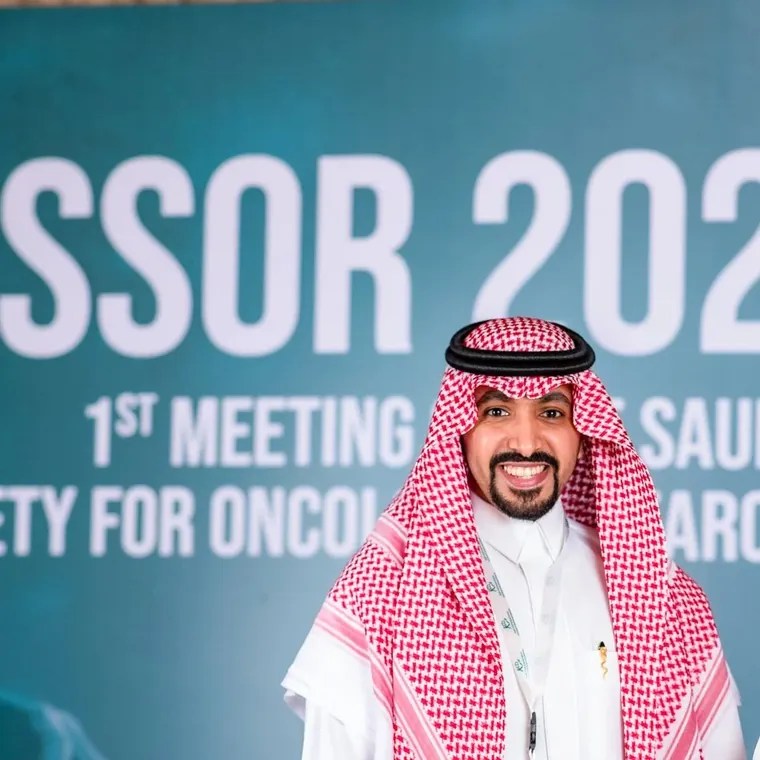
Research team
Dr. Ali A. Alshamrani
BPharm, PhD, PMP · Associate Professor of Pharmacogenomics
Department of Pharmacology and Toxicology
College of Pharmacy, King Saud University
Office 1A6, Building 23 — P.O. Box 2457, Riyadh 11451
aaalshamrani@ksu.edu.sa · +966 11 469 4067
Google Scholar
Background
Professional Summary
Dr. Ali Alshamrani is an Associate Professor of Pharmacogenomics in the Department of Pharmacology and Toxicology at the College of Pharmacy, King Saud University. He obtained his bachelor’s degree in Pharmacy from King Saud University in 2010, and earned his PhD in Pharmaceutical and Biomedical Sciences from the University of Georgia, Athens, Georgia, in 2018.
His research targets cancer therapy resistance, dissecting the signaling pathways and survival strategies that enable tumours to withstand treatment, and identifying vulnerabilities that can re-sensitize cancers to therapy. He is also a co-founder and board member of the Saudi Society for Oncology Research (DAEM).
Research Interests
- The molecular mechanisms by which cellular signaling regulates chemoresistance in cancer cells
- The role of small non-coding RNAs (miRNAs) in regulating different aspects of cancer tumorigenesis
- Identifying novel therapeutic targets to overcome acquired resistance across cancers including melanoma, breast, prostate and colon
- The molecular ramifications of cellular oxidative damage in in vitro and in vivo models
Research Goals
Cancer cells activate several signaling cascades and employ different survival strategies under harsh conditions. Dr. Alshamrani’s research centres on deciphering how cancer cells develop resistance to various treatment approaches, and then targeting these vulnerabilities to re-sensitize them to chemotherapies.
Selected Publications
For a complete list, see Google Scholar.
- Alshamrani AA, Bin Salman SB, Alsaleh NB, Assiri MA, Almutairi MM, Almudimeegh S, Alwhaibi A, As Sobeai HM. miRNA-driven sensitization of breast cancer cells to Doxorubicin treatment following exposure to low dose of Zinc Oxide nanoparticles. Saudi Pharm J. 2024;32(11):102169. doi:10.1016/j.jsps.2024.102169
- Albaqami WF, Alshamrani AA, Almubarak AA, Alotaibi FE, Alotaibi BJ, Alanazi AM, Alotaibi MR, Alhoshani A, As Sobeai HM. Genetic and Epigenetic Biomarkers Associated with Early Relapse in Pediatric Acute Lymphoblastic Leukemia. Biomedicines. 2024;12(8):1766.
- Alsaleh NB, Aljarbou AM, Assal ME, Assiri MA, Almutairi MM, As Sobeai HM, Alshamrani AA, Almudimeegh S, Hatshan MR, Adil SF. Synthesis, Characterization, and Toxicity Assessment of Zinc Oxide-Doped Manganese Oxide Nanoparticles in a Macrophage Model. Pharmaceuticals. 2024;17(2):168.
- Alsaleh NB, Assiri MA, Aljarbou AM, Almutairi MM, As Sobeai HM, Alshamrani AA, Almudimeegh S. Adverse Responses following Exposure to Subtoxic Concentrations of Zinc Oxide and Nickle Oxide Nanoparticles in the Raw 264.7 Cells. Toxics. 2023;11(8):674.
- Al-Harbi NO, Imam F, Al-Harbi MM, Qamar W, Aljerian K, Khalid Anwer M, Alharbi M, Almudimeegh S, Alhamed AS, Alshamrani AA. Effect of Apremilast on LPS-induced immunomodulation and inflammation via activation of Nrf2/HO-1 pathways in rat lungs. Saudi Pharm J. 2023;31(7):1327-1338.

